
 Replacing an ITSM Platform
Challenge
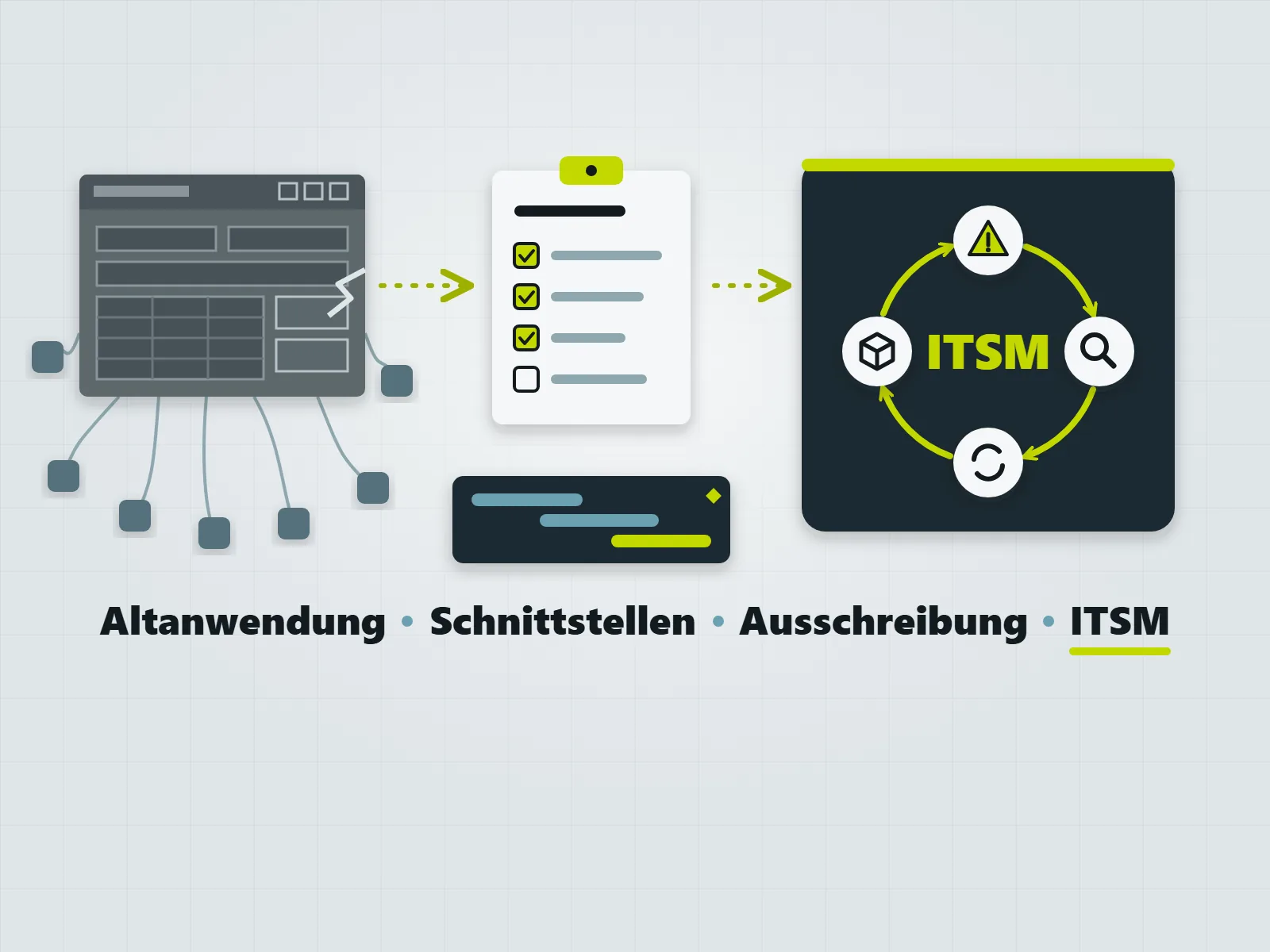
For its operational IT processes, a public administration organisation used an in-house development that had grown over decades. It covers asset, configuration, incident, problem and change management with a complex role concept and is also used by the central IT service provider and its customers. This solution was to be replaced by standard software established on the market.
The existing solution was highly automated and connected to many surrounding systems via numerous interfaces. However, the documentation was incomplete, and knowledge holders changed. The tender had to be flexible enough for a multi-year implementation while meeting all requirements of procurement law. The requirements of all parties involved had to be taken into account, as did information security, data protection and cost-effectiveness.
Solution
hpc.one supported the programme from market exploration through a two-stage, EU-wide negotiated procedure to the programme set-up for implementation. hpc.one was responsible for methodical programme management, requirements management including process documentation, and the programme office with governance and documentation. hpc.one prepared status reports and decision papers for the steering committees.
In its technical consulting, hpc.one produced capability analyses and capability maps and formulated solution-neutral criteria for the tender documents. Weaknesses from ongoing operations, for example in tenant separation and in identity and access management, were incorporated as requirements. A KPI-based pricing model and a generic process model form the basis for the future expansion projects. An accompanying preparatory project additionally developed role and permission concepts for the basic implementation.
Topics
- Programme Management
- Project Management
- Requirements Management
- Process Management
- IT Service Management
- Procurement and Tendering
- Enterprise Architecture
- Change Management
Methods
- ITIL
- USM
- BPMN
- Capability Maps
- KPI-Based Pricing Model
- JIRA and Confluence